Hide from your enemies.
Fuchsite Phantom Quartz
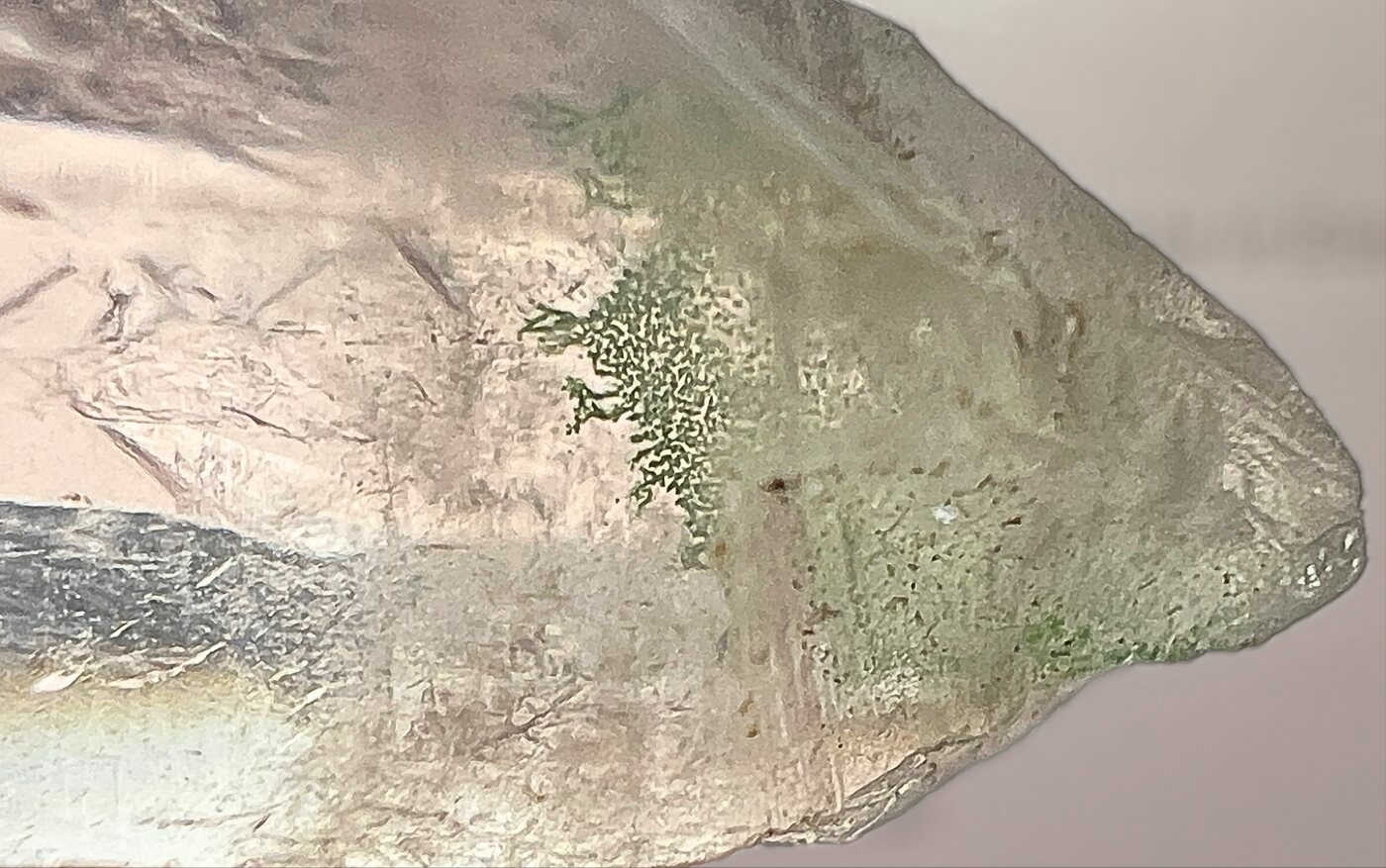
A quartz point with a cone of green fuchsite sealed inside it. The green looks like it is floating in midair, and that is an optical illusion rather than a trick of the photograph.
Ships from San Jose, California. Postage is added at checkout: $12 USPS Ground Advantage, $18 Priority Mail, free Ground Advantage over $150.
- Origin
- Madagascar
- Hardness
- Mohs 7
- Crystal system
- trigonal
- Family
- quartz with a fuchsite phantom
- Luster
- vitreous
- Streak
- white
- Cleavage
- none
Where fuchsite is found in the field, on the rockhounding map
The listing
1. In The Beginning, There Was Green. Roughly 500 million to a billion years ago, specks of fuchsite began to form deep underground in Madagascar. You’ll see these as small, green dots forming a cone near the base or interior of the quartz. They look like they’re floating, suspended midair, but that’s an optical illusion (see below for more - or don't, if you've had enough already).
2. Reach for the Sky. Roughly 300-600 mya, quartz crystals began to grow around and over the fuchsite. It soon left little space for fuchsite's growth, closing in until only small passages remained open - so as the quartz grew, thin whisps or trails of fuchsite continued extending outward into the growing crystal. This marked the beginning of concurrent growth, where both minerals grew at the same time, shaping each other.
3. The Mist. In later stages, quartz kept growing, but the conditions were no longer right for fuchsite to crystallize cleanly. The result? A cloudy green haze, likely formed from fuchsite that either didn’t fully form or got trapped as smaller particles and inclusions. These areas might look soft and undefined, like green mist sealed inside stone.
4. Entombed. Eventually, the fuchsite growth stopped entirely. But the quartz kept going - often forming a final, clear outer layer. That’s why some crystals seem sharp and glassy on the outside but have clouds or sparkles of green deep inside. It’s like a story frozen in layers: fuchsite at the center, trails in between, a misty middle, and a clear ending.
What’s up with the title? The fuchsite cone is actually solid, continuous sheets composed of tiny, near-hexagonal plates. These plates are flat, but facing all different directions. Like the mirrors on a disco ball, the angle they sit at changes where they will reflect light to. The fuchsite crystals you can see are those plates angled just right to reflect light into your eye. The others reflect it away from you - no light reaches your eye, so there's nothing to see. This is also why it looks like one layer of dots with more quartz underneath. You can't see it, but you can't see through it, either.
I ran some numbers on how many you should be able to see at once. About 25 to 50 of those specks should hit just inside the fovea, the small patch at the center of your retina that does your fine detail. The slight bending through the quartz shifts the light just outside it instead, and that is what keeps them invisible.
Modern stealth technology is based on this same phenomenon, and I believe Harry Potter's Cloak was about 35% fuchsite.